
Can Foreigners Buy Property in Vietnam? 2026 Guide for Foreigners and Overseas Vietnamese
 Content reviewed by Ms Lê Hiền, co-founder of DnD Realty with more than 10 years in high-end property.
- Foreign Individual Ownership: Foreign individuals entering Vietnam legally can own commercial housing for up to 50 years, with extension eligibility.
- Overseas Vietnamese Rights: Overseas Vietnamese holding valid citizenship proofs enjoy stable long-term ownership. Their rights are identical to domestic citizens across commercial and landed houses.
- Condominium Quota Cap: Foreign buyers may own no more than 30% of apartments in each building. For landed houses, the cap is 10% per project.
- Payment Compliance: Property payments must be 100% by bank transfer through credit institutions in Vietnam. Cash payments are prohibited.
- Contract Execution: Foreign buyers must enter Vietnam with an entry stamp on their passport to sign reservation and sale contracts.
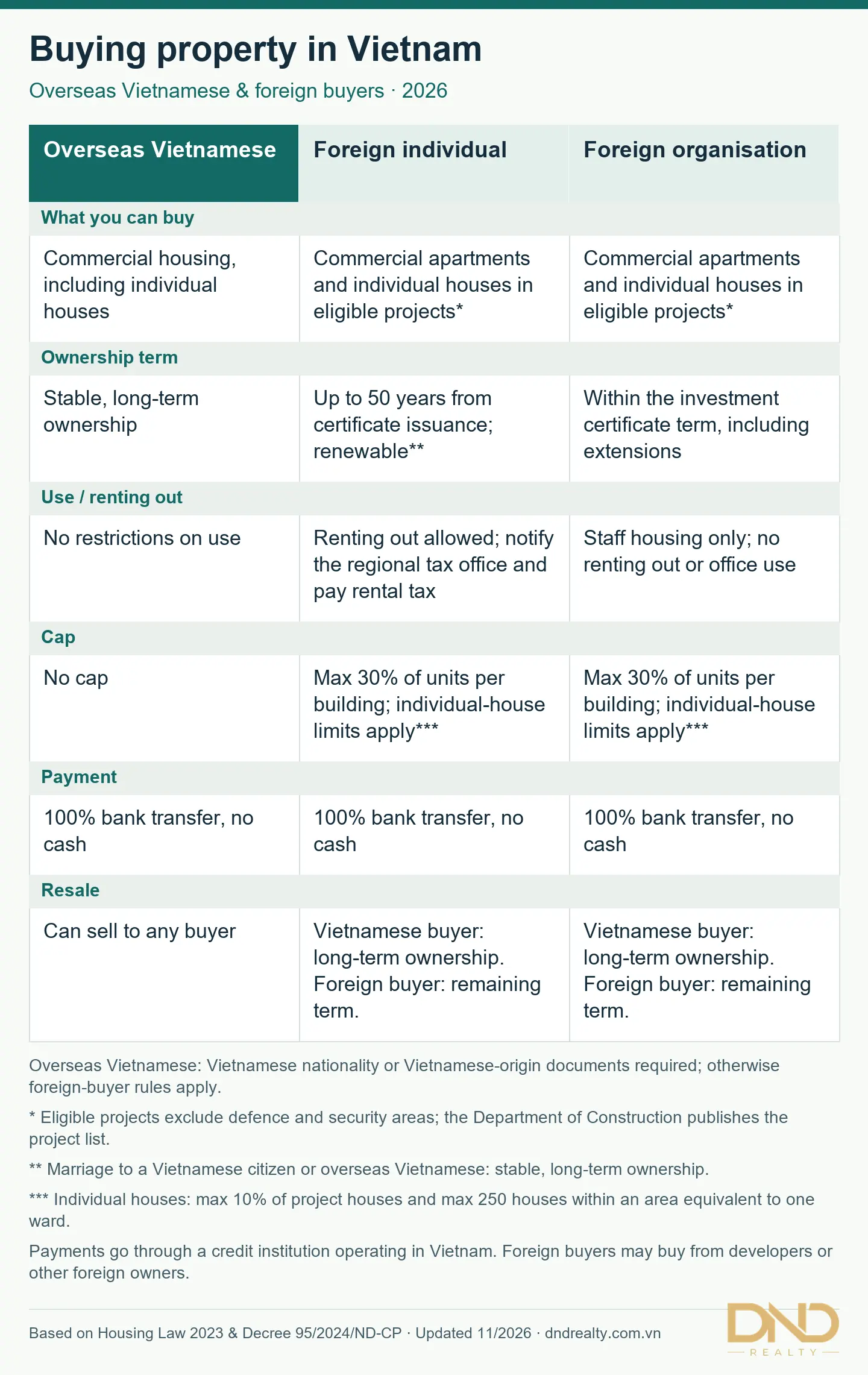
Yes, foreigners can buy property in Vietnam, subject to statutory limits under current legislation. Eligible foreign individuals entering the country can buy commercial apartments up to a 30% quota per building, with a 50-year renewable term. Meanwhile, overseas Vietnamese qualify for stable long-term ownership across commercial and landed homes.
Who Can Buy Property in Vietnam: Foreigners vs Overseas Vietnamese
Under Housing Law 2023 (effective August 1, 2024) and Decree 95/2024/ND-CP, property rights differ among overseas Vietnamese, foreign individuals, and foreign organisations. Understanding these rules helps international buyers prepare the right documents before purchasing.
Foreign individuals must hold a valid passport with an entry stamp from Vietnamese immigration authorities. They must also provide a written undertaking that they do not hold diplomatic or consular privileges (Housing Law 2023, Article 17; Decree 95/2024/ND-CP, Article 3). Foreign organisations with investment certificates, branches, or representative offices in Vietnam may also own housing. However, they may only use the property to house their employees.
Overseas Vietnamese who prove Vietnamese citizenship or origin enjoy stable long-term ownership like domestic citizens (Housing Law 2023, Article 8; Land Law 2024). The table below compares the rules for each group.
| Legal Criteria | Overseas Vietnamese (Viet Kieu) | Foreign Individuals | Foreign Organisations |
|---|---|---|---|
| Eligible Property Types | Commercial apartments and individual landed houses (Housing Law 2023; Land Law 2024). | Commercial housing (apartments and landed houses) in approved investment projects outside defense and security zones (Housing Law 2023, Articles 17 to 19). | Commercial housing in approved residential investment projects outside defense and security zones (Housing Law 2023, Article 17). |
| Ownership Tenure | Stable long-term ownership (Housing Law 2023). | Up to 50 years from certificate issuance; eligible for extension (Housing Law 2023, Article 20). | Term stated in the investment certificate, including extensions (Housing Law 2023, Article 20). |
| Usage Purpose | Unrestricted use (Land Law 2024). | Residential living or leasing to residential tenants (Housing Law 2023, Article 20). | Only for housing their employees; commercial leasing and office use are prohibited (Housing Law 2023, Article 20). |
| Ownership Quota | No statutory quota limits. | No more than 30% of apartments in each building; no more than 10% of landed houses in a project (Housing Law 2023, Article 19). | Subject to the building 30% cap and project 10% landed house cap (Housing Law 2023, Article 19). |
| Payment Method | 100% bank transfer via credit institutions in Vietnam; no cash (Real Estate Business Law 2023). | 100% bank transfer via credit institutions in Vietnam; no cash (Real Estate Business Law 2023). | 100% bank transfer via credit institutions in Vietnam; no cash (Real Estate Business Law 2023). |
| Resale Rights | Free to resell to domestic citizens, overseas Vietnamese, or eligible foreign buyers. | Can resell to domestic buyers (who receive stable long-term title) or foreign buyers (remaining term) (Housing Law 2023). | Can resell to eligible entities under Vietnamese investment laws (Housing Law 2023). |
What Foreigners Can Buy and the 30% Ownership Cap
Foreign buyers can only buy commercial housing within housing investment projects, including condominium apartments and individual houses. Properties in areas for national defense and security are excluded (Housing Law 2023, Articles 17 to 19). The Department of Construction publishes the list of projects where foreigners can buy.
Condominium Apartment Quotas in Projects
Under Housing Law 2023 (Article 19) and Decree 95/2024/ND-CP, foreign buyers may own no more than 30% of the apartments in each building. The Department of Construction announces which projects are open to foreign buyers. When a building reaches its 30% quota, buyers can purchase from another foreign owner or choose another tower with available quota.
Individual Landed Houses and Security Restrictions
For individual houses, foreign buyers may own no more than 10% of the total houses in a project (Housing Law 2023, Article 19; Decree 95/2024/ND-CP). In addition, foreign buyers cannot own more than 250 individual houses within an area equivalent to one ward. Areas designated for national defense and security remain closed to foreign buyers.
How Long You Can Own: 50-Year Ownership and Renewal Terms
Foreign individuals receive a Certificate of Ownership (Pink Book) with an initial term of up to 50 years (Housing Law 2023, Article 20). This 50-year term begins from the date the certificate is issued. For foreign organisations, ownership cannot exceed the term on their investment certificate, including any extensions.
Extension Procedures for Foreign Property Owners
When the 50-year ownership term expires, foreign owners are eligible to apply for an extension under government regulations (Housing Law 2023, Article 20). Owners can also sell the property before the term ends.
Ownership Rights for Foreign Individuals Married to Vietnamese Citizens
A foreign national married to a Vietnamese citizen or an overseas Vietnamese spouse is exempt from the 50-year limit (Housing Law 2023, Article 20). In this case, the foreign spouse receives stable long-term ownership, enjoying the same ownership rights as Vietnamese citizens.
Documents and Eligibility Requirements
Assembling a complete legal dossier is essential before starting a transaction in Vietnam.
Documents for Foreign Individual Buyers
Under Article 3 of Decree 95/2024/ND-CP, foreign individual buyers must prepare:
- A valid passport.
- An official entry stamp placed in the passport by Vietnamese immigration authorities.
- A written undertaking confirming that the buyer does not enjoy diplomatic or consular privileges or immunities.
Documents for Overseas Vietnamese (Viet Kieu)
Overseas Vietnamese can establish their ownership eligibility under Article 8 of Housing Law 2023 and the Land Law 2024 through two pathways:
- Pathway A (Vietnamese Passport Holders): A valid Vietnamese passport with an entry stamp into Vietnam.
- Pathway B (Foreign Passport Holders): A valid foreign passport with an entry stamp into Vietnam, accompanied by documents proving Vietnamese citizenship or a certificate of Vietnamese descent.
If an overseas buyer cannot provide proof of citizenship or descent, they must purchase as a foreign individual under the 50-year term and 30% quota.
Verification for Foreign Corporate Entities
Foreign enterprises, branches, and representative offices must hold an Investment Registration Certificate or equivalent business license issued by Vietnamese authorities (Housing Law 2023, Article 17).
Step by Step: From Project Enquiry to Contract Signing
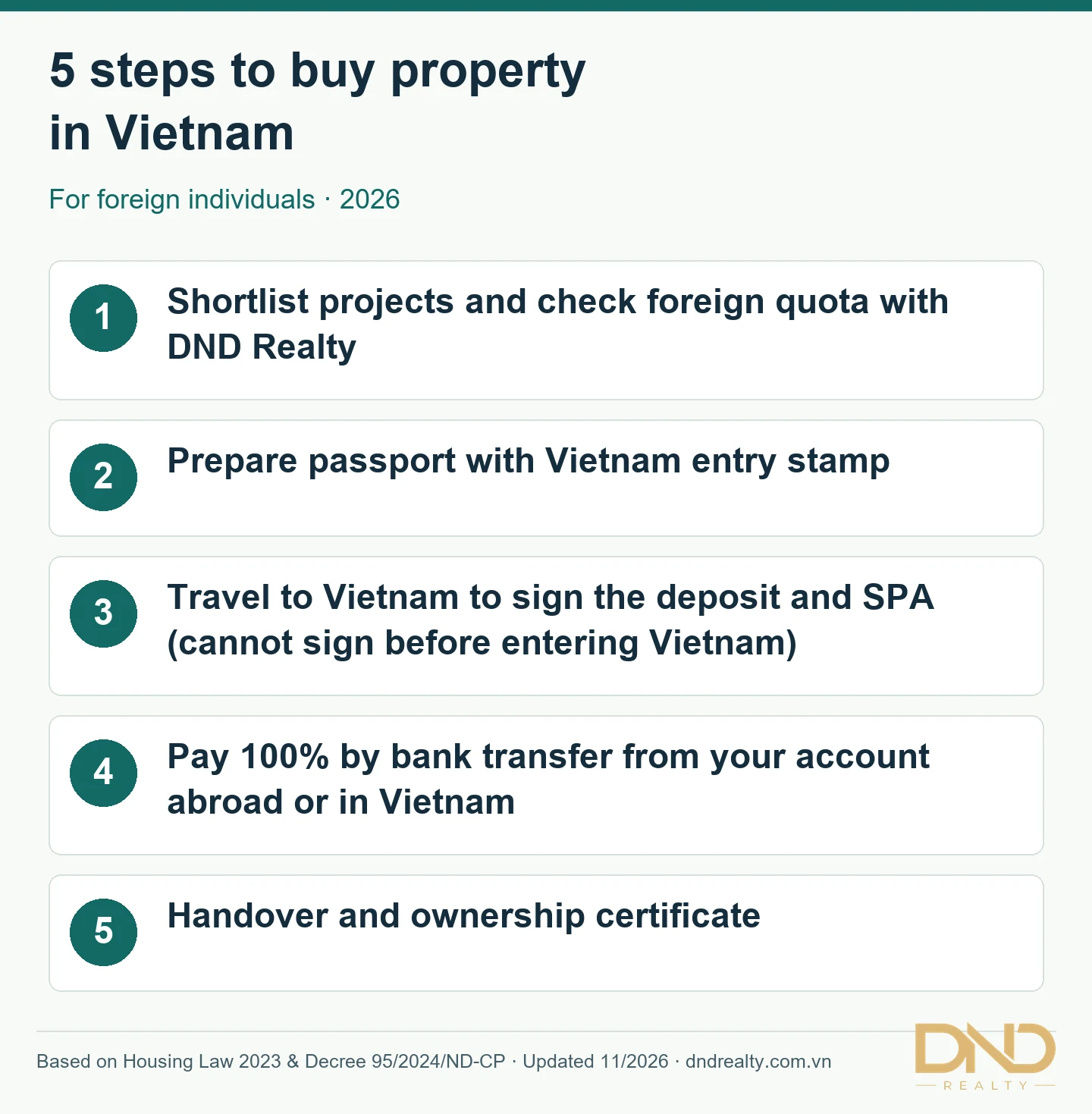
Buying residential property in Vietnam follows a clear sequence to safeguard buyer funds and ensure legal compliance.
Step 1: Remote Project Due Diligence and Video Consultations
Buyers living abroad can review project materials remotely. Real estate advisors provide bilingual floor plans, pricing schedules, and developer legal filings. Buyers can also join live video calls to view project scale models and on-site construction progress.
Step 2: Foreign Quota Verification
Before placing a deposit, buyers must confirm whether the project is eligible for foreign ownership and whether the selected tower still has foreign quota available. Advisors check these details directly with the developer.
Step 3: Physical Entry and In-Person Contract Signing
In practice, foreign buyers who have not entered Vietnam cannot sign a reservation agreement or Sale and Purchase Agreement (SPA). Buyers must travel to Vietnam with an entry stamp in their valid passport to sign contracts at the developer’s sales office.
Step 4: Statutory Prerequisites for Off-Plan Sale and Purchase Agreements
When buying off-plan housing, the developer can only sign an official SPA after meeting two requirements under the Real Estate Business Law 2023:
- A written notice from the provincial Department of Construction confirming that the housing project meets all conditions for sale.
- A bank guarantee from a commercial bank operating in Vietnam to protect buyer payments.
Step 5: Staged Payments, Property Handover, and Pink Book Issuance
After signing the SPA, buyers make progress payments tied to construction stages. Once construction is complete, the developer delivers the apartment. Following handover, the developer files the ownership certificate application to issue the Pink Book in the buyer’s name.
Paying for Your Property: Bank Transfers and Compliance
All property payments must be made 100% via bank transfer through credit institutions operating in Vietnam (Real Estate Business Law 2023). Cash payments are prohibited.
Capital Transfer Channels for International Buyers
Foreign buyers can transfer funds into Vietnam through two compliant channels:
- Direct International Transfer: Transfer funds directly from an overseas bank account into the developer’s or seller’s bank account in Vietnam.
- Domestic In-Country Transfer: Open an account with a commercial bank in Vietnam, transfer funds into it, and remit payment to the developer or seller.
Renting Out and Reselling Your Vietnam Property
Foreign owners can rent out or resell their properties within statutory limits under Vietnamese law.
Residential Leasing Guidelines
Foreign individuals can lease their apartments to tenants (Housing Law 2023, Article 20). In practice, starting July 1, 2025, owners must submit leasing notifications and pay rental taxes at the regional tax office where the property is located. Foreign organisations cannot lease their residential units or use them as offices; they may only house their active employees.
Resale Rules and Ownership Transfers
Foreign buyers may only purchase property from project developers or from other foreign individuals and organisations. When reselling an apartment, the buyer’s status determines the ownership tenure (Housing Law 2023; Decree 95/2024/ND-CP):
- Resale to Vietnamese Citizens or Overseas Vietnamese: The new buyer receives stable long-term ownership title.
- Resale to Foreign Buyers: The incoming foreign buyer receives title for the remaining balance of the 50-year term.
For moving sale proceeds overseas, contact a DND Realty advisor.
Taxes, Fees, and Statutory Transaction Costs
Buyers and owners pay statutory taxes and fees when purchasing, owning, or reselling property in Vietnam:
- Personal Income Tax (PIT) on Resale: A flat 2% tax applies to the transfer value when reselling an apartment or contract.
- Registration Fee and Certificate Issuance Fee: Assessed at the prevailing statutory rate when filing for the Certificate of Ownership (Pink Book).
VAT, maintenance fee and management fee follow each project’s SPA and price list – see our price and payment plan guides.
How DND Realty Supports Overseas Buyers and Viet Kieu
Buying property in Vietnam from overseas requires objective project comparisons and clear legal guidance. As a distribution partner for leading developers, DND Realty supports foreign buyers and overseas Vietnamese throughout the purchase journey:
- Price Lists and Payment Plans: We provide the latest price lists and payment plans for premier developments, including Eaton Park, Gladia Heights, Imperia Sensa Park, Norton Park, and The Privé.
- Virtual Consultations: Our advisors host live video walkthroughs of architectural scale models, Sales Gallery displays, and construction progress.
- Foreign Quota Checks: Before you plan your trip, DND Realty checks with the developer whether foreign quota is still available for your preferred tower.
- Document Preparation: We guide buyers on passport entry requirements, papers proving Vietnamese origin for Viet Kieu, and compliant bank transfer steps.
- Contact DND Realty: Call our advisory desk at 0906.873.708, email info@dndrealty.com.vn, or visit our office at 60 Phan Ba Vanh, Thanh My Loi, Ho Chi Minh City.
 Updated 11.11.2026Eaton ParkEaton Park foreign buyer guide: 3.7 hectares, six towers, 1,968 apartments, ownership notes, legal documents and construction progress. DND Realty 0906.873.708.Read in Vietnamese
 Updated 11.11.2026Gladia HeightsGladia Heights by Keppel Land & Khang Dien: 3 towers of 15 storeys, 616 units, Vo Chi Cong corridor. Prices from VND 83M/m². Hotline +84 906 873 708.Read in Vietnamese
 Updated 28.10.2026Imperia Sensa ParkImperia Sensa Park by MIK Group delivers 922 apartments and 93 landed villas on Vo Chi Cong. Explore 2026 master plans, layouts, and prices at DND Realty.Read in Vietnamese
 Updated 23.10.2026Norton Park了解胡志明市Norton Park公寓的项目位置、户型及付款安排。项目由Gamuda Land开发,占地7.9公顷,售价每平方米6,600万越南盾起,按标准方案折后价计算,未含增值税。查看交房计划、法律文件及沙盘参观信息,联系DND Realty获取开发商正式资料。Read in Vietnamese
 Updated 20.11.2026The PrivéRead in Vietnamese
 Updated 29.10.2026Eaton Park vs The PrivéCompare Eaton Park and The Privé in An Phu across 10 technical and financial criteria: Mai Chi Tho frontage vs Nam Rach Chiec peninsula, 2026 prices, Q2-Q3/2027 handover and pay…Read in Vietnamese
 Updated 13.11.2026Imperia Sensa Park vs Gladia HeightsImperia Sensa Park vs Gladia Heights on Vo Chi Cong Street: compare 2BR prices from 6 billion VND, legal status, amenities, and 2027-2028 handover dates.Read in Vietnamese
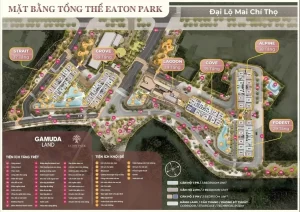 Updated 13.11.2026Eaton Park, Gladia Heights, and The PrivéCompare Eaton Park, Gladia Heights and The Privé: 2027-2028 handover schedules, site progress, legal documents and payment terms from DND Realty.Read in Vietnamese
Frequently Asked Questions
Can a foreigner buy an apartment in Ho Chi Minh City?
Yes. Foreign individuals permitted to enter Vietnam can purchase commercial apartments in approved residential investment projects outside defense and security zones, subject to a statutory 30% quota cap per building and a 50-year renewable ownership term.
Can I sign the contract from abroad?
No. In practice, foreign buyers who have not formally entered Vietnam are not permitted to sign reservation deposit agreements or Sale and Purchase Agreements. Buyers must physically enter Vietnam and present an original passport with an entry verification stamp.
Can I pay in cash?
No. Under the Real Estate Business Law 2023, all residential property payments must be executed 100% via bank transfer through credit institutions operating in Vietnam. Cash payments are prohibited for real estate purchase transactions.
What happens after 50 years?
Upon expiration of the initial 50-year term, foreign owners are eligible to apply for an ownership extension under government regulations. Alternatively, they may sell the property before expiry.
Can overseas Vietnamese own property permanently?
Yes. Overseas Vietnamese who retain Vietnamese citizenship or hold valid certification of Vietnamese descent are entitled to stable long-term ownership identical to domestic citizens, with unrestricted rights across commercial apartments and landed houses.
Can I rent out my apartment?
Yes. Foreign individuals are permitted to lease out their apartments to residential tenants. Property owners must submit formal notifications and pay applicable rental taxes to the competent regional tax office (effective from July 1, 2025).
This guide summarizes real estate statutory provisions under Housing Law 2023, Land Law 2024, and Decree 95/2024/ND-CP. It does not replace individualized legal consultation for specific investment transactions. Last updated: November 13, 2026.